

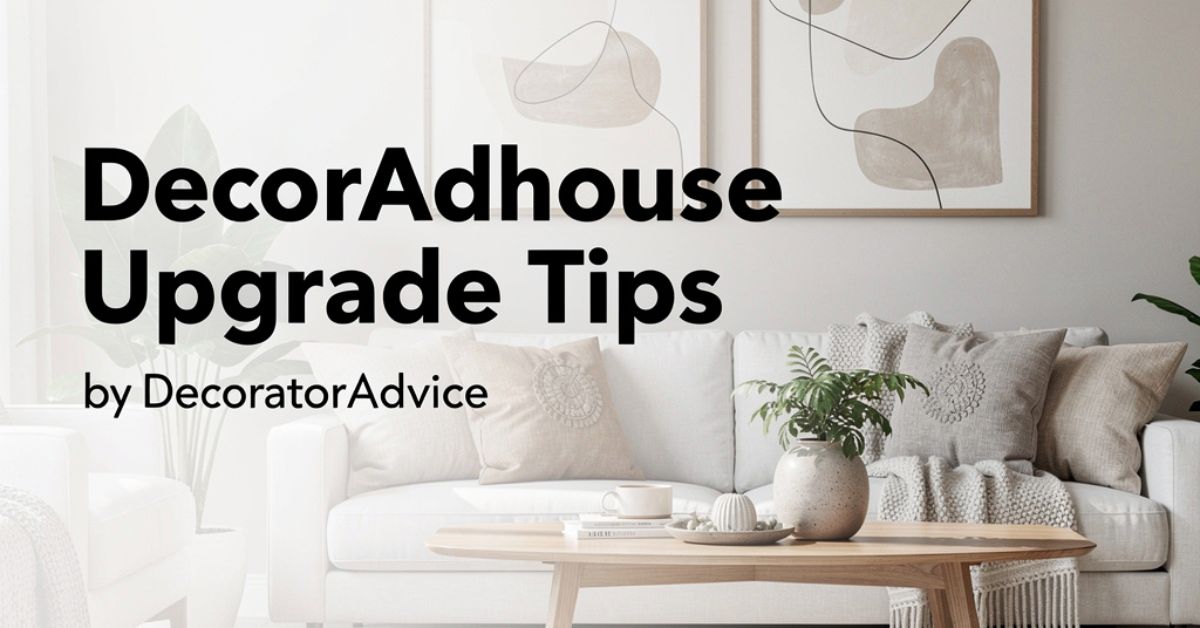
Why Most Home Improvement Advice Does Not Actually Help
If you have ever searched for home upgrade ideas online, you already know the frustration. You find a list of tips, read through them, and walk away with a vague sense that you should “declutter your space” or “add a statement piece” — but no clearer idea of what to actually do on Saturday morning when you are standing in your living room with a free hour and a $200 budget.
The problem with most home improvement content is that it stays at the surface. It tells you what to do without explaining why it works, how much it costs, or what to prioritize first. That leaves homeowners, especially first-timers, either paralyzed by options or spending money on changes that do not move the needle.
Good home upgrade advice is specific. It connects to real situations, explains the reasoning behind each change, and respects the fact that most people are working with real budget constraints and real time limits.
DecorAdhouse upgrade tips by DecoratorAdvice refer to a collection of home improvement and interior decorating strategies curated through the DecorAdhouse and DecoratorAdvice approach — focused on helping homeowners and renters make meaningful, practical improvements to their living spaces through smart material choices, layout changes, styling decisions, and targeted upgrades that deliver visible results without requiring professional design experience or large renovation budgets.
Quick Summary
This guide covers the most effective home upgrade tips from the DecorAdhouse and DecoratorAdvice perspective — organized by impact level, explained clearly, and grounded in what actually works in real homes across the US and beyond.
Start With the Right Mindset About Home Upgrades
Before getting into specific tips, it is worth being direct about one thing: the most effective home upgrades are almost never about spending more money. They are about making better decisions with whatever you have.
A $50 can of paint applied to the right wall does more for a room than a $500 decorative item placed without thought. A furniture rearrangement that costs nothing can transform the entire feel of a living space. Removing clutter — which also costs nothing — consistently makes rooms feel larger, calmer, and more intentional.
The DecorAdhouse approach to home upgrading is built on this principle: start with what you have, make strategic changes, and add new elements only when they solve a specific problem or serve a clear purpose.
With that foundation in mind, here are the upgrade tips that make the biggest real-world difference.
Living Room Upgrades That Actually Work
The living room is where most homeowners want to start — and for good reason. It is the most-used social space in most homes, and it sets the tone for how the entire property feels to visitors and residents alike.
Rearrange Before You Redecorate
The single highest-impact, zero-cost change you can make to a living room is rearranging the furniture. Most people push furniture against the walls, which actually makes rooms feel smaller and less connected rather than larger and more open.
Pull seating away from the walls and arrange it around a central focal point — a coffee table, a fireplace, or a rug. Create a conversation arrangement where seats face each other rather than all pointing at the television. This change alone makes a room feel more intentional and professionally designed.
A homeowner in Denver rearranged her living room using this principle and described it as feeling like a completely different apartment — without buying a single new item.
Upgrade Your Lighting Layers
Most living rooms rely on one central overhead light. This creates flat, uninviting illumination that makes even well-furnished spaces feel institutional. Professional designers always work with multiple light sources at different heights.
Add a floor lamp in a dark corner. Place a table lamp on a side table. Add a small accent light on a bookshelf or console. This layering — overhead light plus mid-level plus low-level — creates warmth, depth, and a sense of deliberate design that a single ceiling fixture simply cannot achieve.
Dimmer switches are one of the cheapest upgrades available. A basic dimmer costs around $15 to $25 and transforms how a room feels in the evening.
Anchor the Space With the Right Rug
If your living room rug is too small — which is the most common rug mistake in US homes — it makes the space look unfinished and proportionally off. A rug should be large enough for all furniture legs to sit on it, or at minimum for the front legs of all seating pieces to rest on the edge.
An 8×10 rug is the standard minimum for a typical American living room. Many people buy 5×7 or 6×9 rugs for spaces that need larger ones and then wonder why the room never looks quite right. Getting the rug size correct is one of the most immediately impactful changes you can make.
Kitchen Upgrades Without a Full Renovation
Kitchens are the most expensive rooms to renovate properly — but there are several high-impact changes that deliver a significant visual upgrade at a fraction of the cost of full remodeling.
Replace Cabinet Hardware
Cabinet handles and drawer pulls are the jewelry of a kitchen. Original builder-grade hardware is almost always cheap-looking and generic. Replacing it with brushed brass, matte black, or satin nickel hardware takes an afternoon and costs between $50 and $200 depending on the number of cabinets.
The visual transformation is out of proportion to the cost. It is one of the highest-impact-per-dollar upgrades in any kitchen.
Add Under-Cabinet Lighting
Under-cabinet lighting illuminates the countertop workspace, eliminates the shadow created by overhead lighting, and makes a kitchen feel noticeably more modern and functional. Plug-in LED strip lights that require no electrical work start at around $25 to $40 for a standard kitchen.
This upgrade makes the kitchen more practical for cooking and dramatically improves the visual quality of the space — especially in the evening.
Paint or Refinish Cabinet Doors
If cabinet hardware is the jewelry, the cabinet doors themselves are the clothing. Painting cabinet doors in a fresh, modern color — a deep navy, a clean white, a warm sage green — can make a kitchen that feels dated look ten years newer.
This is a weekend project that requires preparation, the right primer, and patience. Done properly, painted cabinets look professional and last for years. Done poorly, they peel and chip within months. Take the time to sand, prime, and use a cabinet-specific paint formulation.
Bedroom Upgrades for Better Rest and Better Style
The bedroom is where the decoradhouse upgrade tips by decoratoradvice approach places a strong emphasis on function alongside aesthetics — because a bedroom that looks good but does not support quality sleep has failed at its primary job.
Invest in Your Bedding
The bed is the focal point of every bedroom. What you put on it determines how the entire room reads visually. Quality bedding — a well-fitted duvet cover, matching pillow shams, and two or three decorative pillows — transforms a bed from a sleeping surface into the visual anchor the room needs.
You do not need to spend hundreds on designer bedding. Clean, high-quality cotton or linen in a solid neutral or simple pattern will almost always look better than cheap patterned sets, regardless of price difference.
Control Natural and Artificial Light
Bedrooms need two different light conditions: bright morning light to support waking up naturally, and complete darkness for quality sleep. Most bedrooms achieve neither.
Blackout curtains or lined drapes solve the darkness problem. Sheer curtains layered behind them allow natural light during the day while maintaining the option for full blackout at night. This layered window treatment approach — sheers plus blackout — is what professional designers use in bedroom settings.
The difference in sleep quality is worth the investment. Blackout curtain panels start around $25 to $40 per panel.
Clear the Surfaces
Visual clutter in a bedroom directly affects how restful the space feels. Every item sitting on your nightstand, dresser, or windowsill that does not have a specific daily purpose adds to the visual noise of the room.
Remove everything from surfaces and only return what genuinely belongs there. A lamp, a book, and a small plant on a nightstand looks intentional. A collection of chargers, receipts, jewelry, water bottles, and random objects looks chaotic — and affects how the room feels even when you are not consciously noticing it.
Bathroom Upgrades With High Visual Return
Bathrooms are small spaces where the quality of finishes is immediately apparent. Even minor upgrades read as significant improvements because there is nowhere for poor quality to hide.
Replace Towels and Bath Mats
Old, thin, or color-mismatched towels make even a clean bathroom look neglected. A matched set of quality towels in a single neutral color — folded and displayed rather than piled — changes the look and feel of the space immediately.
This is a $30 to $60 investment that has immediate, visible impact.
Update Fixtures Where Possible
Towel bars, toilet paper holders, and faucet handles are often the original builder-grade versions in older homes — chrome or brushed nickel that has dulled or corroded over time. Replacing these with a consistent finish — all matte black, all brushed brass, or all polished chrome — creates the cohesion that makes a bathroom feel upgraded.
A Quick Reference: Upgrades by Impact and Cost
| Upgrade | Room | Estimated Cost | Impact Level | DIY Friendly |
|---|---|---|---|---|
| Furniture rearrangement | Living room | $0 | Very High | Yes |
| Rug sizing correction | Living room | $80–$300 | Very High | Yes |
| Dimmer switches | Any room | $15–$25 each | High | Yes |
| Cabinet hardware replacement | Kitchen | $50–$200 | High | Yes |
| Under-cabinet lighting | Kitchen | $25–$60 | High | Yes |
| Quality bedding upgrade | Bedroom | $60–$150 | High | Yes |
| Blackout curtains | Bedroom | $50–$100 | High | Yes |
| Fresh paint — accent wall | Any room | $30–$80 | Medium-High | Yes |
| Towel and bath mat set | Bathroom | $30–$60 | Medium | Yes |
| Layered lighting addition | Living room | $40–$150 | Very High | Yes |
Upgrades Worth Avoiding (Or Delaying)
Honest advice means telling you what not to do, not just what to do.
Avoid trendy paint colors on large surfaces. Trending colors look great in magazines and quickly look dated in real homes. Stick to timeless neutrals for large walls and use trend colors in easily swappable elements like cushions and accessories.
Do not buy new furniture before fixing layout problems. New furniture in a poorly arranged room still looks wrong. Fix the arrangement first, then evaluate what you actually need.
Skip open shelving in kitchens unless you are highly organized. Open shelving looks beautiful in styled photographs and requires constant maintenance in real daily use. For most households, closed cabinet storage is more practical.
Do not rush major upgrades to meet a deadline. Rushed renovation decisions — paint colors chosen in a hurry, furniture bought without measuring, tiles selected without considering grout color — almost always result in regret and additional spending to fix.
Conclusion
Home improvement does not have to be expensive, complicated, or overwhelming. The most effective upgrades are usually the ones that work with what you already have — improving layout, lighting, and styling before adding anything new.
The decoradhouse upgrade tips by decoratoradvice philosophy is grounded in exactly this approach: make intentional changes, understand why each one works, and build your space gradually with purpose rather than impulse. That method produces results that last and spaces that feel genuinely like yours.
Whether you are refreshing a single room or working toward a whole-home transformation, start with one clear problem, apply one well-understood solution, and let the results guide your next decision. That is how real, lasting home improvement happens.
If this guide gave you practical direction for your next home upgrade, explore more room-specific decorating guides and budget improvement strategies to keep making confident progress on your space.
Frequently Asked Questions
What are the best home upgrade tips for beginners?
Start with furniture rearrangement, layered lighting, updated soft furnishings, and new cabinet hardware. These upgrades are affordable and easy to do yourself.
How can I upgrade my home on a budget?
Paint walls, declutter, improve lighting, replace hardware, and add a quality rug or bedding for a fresh look without spending much.
What home upgrades add the most value before selling?
Kitchen and bathroom updates, fresh neutral paint, improved curb appeal, and modern lighting offer the best return on investment.
How can I make a small room look bigger?
Use light colors, mirrors, floor-length curtains, and furniture with visible legs to create a more open feel.
How often should I update my home décor?
Keep quality furniture for years and refresh cushions, throws, and decorative accessories whenever your space needs a new look.